 Kazanlak

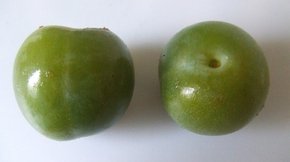
Reine Claude Verte
Ripening time: 10–20 August
Origin: Reine Claude Verte (Große Grüne Reneklode, Green Gage) is one of the oldest and most highly prized plum varieties and the benchmark for the whole greengage group. Its origin is not known for certain – Syria or Armenia are suggested. In France it has been known since the mid-15th century and was named after Queen Claude (1499–1524), wife of Francis I. From 1670 it spread throughout Europe, and in 1724 Sir William Gage brought it to England, where it is known as Green Gage.
Tree: The tree is of medium vigour, with a broad, globular crown. It comes into bearing relatively late, and yields are moderate and somewhat irregular. The fruit develops its full flavour in warm, sunny, sheltered sites.
Flowering and pollinators: The variety is self-sterile and needs a pollinator – Altanova Renkloda, Mirabelle de Nancy and Hanita are suitable. Reine Claude Verte is itself a good pollinator.
Resistance: The variety is not tolerant of plum pox (Sharka), so healthy, certified planting stock is recommended. The fruit is moderately prone to cracking in rain around ripening time.
Fruit: Large, flattened-globular, yellowish-green, with a dull pink blush on the sun-exposed side and numerous subcutaneous dots. The flesh is light brownish-yellow, juicy, fine and melting, very sweet, with low acidity and a pronounced aroma – of excellent eating quality. The stone is medium-sized and free. Ripens around or slightly before Mirabelle de Nancy. The fruit stores well and is suitable for fresh consumption, compotes, jams, pastries and high-quality distillates.